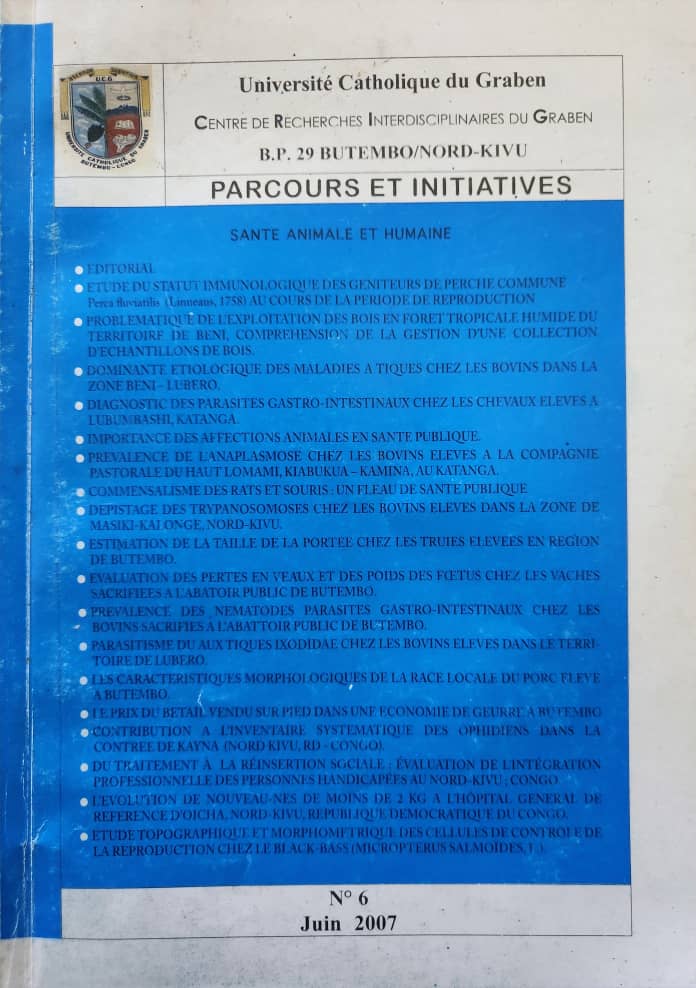
Commensalisme des rats et souris : un fléau de santé publique
Mots-clés :
Rat, souris, commensalisme, importance sanitaire et économique, Rat, mouse, commensalisms, sanitary and economical importanceRésumé
Dans la présente étude, l’auteur expose l’aperçu des particularités biologiques et des ressources écologiques qui contribuent à l’établissement et à l’accroissement des populations des rats et des souris sauvages dans l’environnement immédiat de l’homme. Il évoque (i) l’importance sanitaire et économique du commensalisme et (ii) la nécessité et l’urgence d’une implication effective de tous les Pays infestés de petits rongeurs dans la lutte contre ces derniers.
Abstract :
In the present study, the author presents an outline of biological characteristics and ecological resources that contribute to the establishment and the increase of rat populations and wild mousse in the environment close to man. Emphasis is put on (i) the sanitary and economical importance of commensalisms and (ii) the necessity of and urgency of an effective implication of all countries infested with small rodents in fighting them.
Téléchargements
Références
BARNETT S.A.: Damage to wheat by enclosed populations of Rattus norvegicus. Journal of Hygiene (Cambridge) 49 (1951) 22 - 25.
BARNETT S.A.: Experiments on neophobia in wild and laboratory rats. British Journal of Psycology, 49 (1958) 195 - 201.
BERRY R.J., JAKOBSON M.E.: Life and death in an island population of house mouse. Experimental Gerontology, 6 (1971) 187 - 197.
BRONSON F.H.: The adaptability of the house mouse. Scientific America, 250 (1984) 90 - 92.
BROOKS J.E.: A review of commensal rodents and their control. CRC Critical Review of Environmental Control, 3 (1973) 405 - 453.
BROOKS J.E. ; ROWE F.P.: Commensal rodent control. WHO, Vector Biology and Control Division, Rome, (1987) 107 pp.
CROWCROFT P.: Mice all over. London. Foulis (1966).
HARRISON J.L.: Reproduction in rats of subgenus Rattus. Proceedings of the Zoological Society of London, 121 (1973) 673 - 695.
DAVIS D.E.: The characteristics of rat populations. Quartery Review of Biology, 28 (19 53)373 - 401.
HOPF H.S., MORELY G.E.J., HUMPHRIES J.R.O.: Rodent damage to growing crops and to farm and village storage in tropical and subtropical regions. London, Centre for Overseas Pest Research, Tropical Products Institute, (1976) 115.
HUEBNER R.J., JELLISON W.S.L., ARMSTRONG C.: Rickettsialpox - a newly discovered rickettsial disease. Recovery of Rickettsia akari from a house mouse (Mus musculus). Public Health Reports, 62 (1947) 777 - 780.
MONATH T.P.: Lassa fever: Review of epidemiology and epizootiolgy. Bulletin of the WHO, 52 (1975) 577 - 592.
ROWE F.P., SWINEY T.: Reproduction of the house mouse (Mus musculus) in the farm buildings. Journal of the Zoological Society of London, 199 (1983) 259 - 269.
SCOTT H.G., BOROM M.R.: Rodent borne disease control through rodent stoppage. Atlanta, US Department of Health Education and Welfare, Public Health Service, (1965) 34 pp.
TRAUB R., WISSMAN C.L., FARANG-AZAD A.: The ecology of murine typhus - a critical review. Tropical Diseases Bulletin, 75 (1978) 237 - 317.
TURNER L.H.: A new look of infectious diseases, Leptospirosis. British Medical Journal, 1 (1973) 537 - 540.
ZEIGLER P.: The black death. London. Collins -1969).
Publiée
Comment citer
Numéro
Rubrique
(c) Tous droits réservés Parcours et Initiatives : Revue interdisciplinaire du Graben (PIRIG) 2007

Ce travail est disponible sous la licence Creative Commons Attribution 4.0 International .